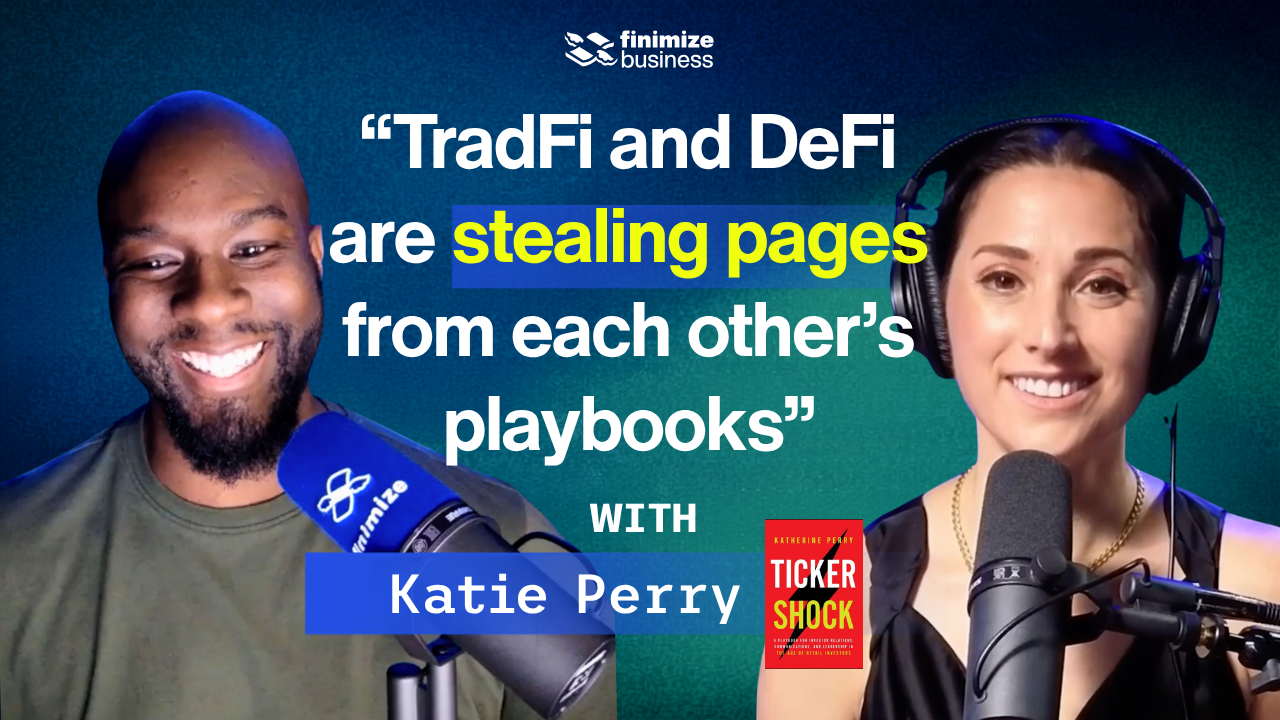
Retail investors now move markets, and most IR teams are still resourced and trained to talk to a dozen analysts and a handful of journalists. Katie Perry – CMO of zerohash and author of the new book Ticker Shock – has spent the last six years watching that gap widen, first building retail investor trust at the investing app Public, then advising public companies on their retail investor relations strategy.
Her argument: this isn't a harder version of traditional IR. It's customer engagement, running through people who've never been trained to do it.
We sat down with her to unpack why, and what an investor relations strategy built for retail actually looks like.
Retail investor relations is a different discipline, not a harder version of IR
Perry's central claim is a reframe most IR teams haven't made yet: the skills that win with retail investors – audience-building, narrative, tone, channel strategy – are customer engagement skills, and they sit in marketing, not traditional IR. "It's actually not fair to ask IR people, who are used to doing specific things, to suddenly know how to write a thread on X that's going to capture attention," she told us. "Very different skills."
That's not a knock on IR teams. It's a structural problem baked into how most investor relations strategy gets built. They're optimising towards one metric – the share price – that retail engagement work often doesn't move for a quarter or two, while reporting into a CFO who's watching that same number. The fix Perry proposes isn't a bigger IR budget. It's pulling retail investor relations structurally closer to the marketing function that already knows how to do this.
Your narrative isn't yours to control anymore
The old playbook – press release, a hit on CNBC, job done – assumed a handful of gatekeepers controlled the story. Perry's point: that's just not true anymore. A press release can go out cleanly and still lose to "the TikTok that takes a completely different interpretation of what you've put out there and runs with it." Reddit, X, creators, newsletters, and now AI-generated summaries all sit alongside the analysts and journalists a three-person IR team is used to tracking.
Her practical fix starts smaller than most teams expect: know who you're actually talking to before you write anything. A biotech company briefing an analyst can use jargon and skip context – the analyst lives in that world every day. The same company talking to retail investors needs to explain what a Phase 3 trial actually unlocks. That's not dumbing anything down, Perry is clear – it's adding a step for an audience that isn't in the sector day-to-day. Skip it, and you're not being concise, you're being unclear.
The real blocker is skillsets and bandwidth, not willingness
Ask Perry why more companies haven't already made this shift, and the answer isn't culture – it's capacity. She's been "absolutely shocked" by how small IR teams are at companies with huge market caps, often three people handling a job that increasingly needs a producer, a script writer and a video editor on top of the traditional analyst relationships. Most of that skill set sits in marketing, and most IR teams sit organisationally a long way from it.
Her recommended starting point isn't a content calendar. It's an audit: get a non-objecting beneficial owner (NOBO) list, understand who actually holds your stock and through which apps, and run social listening on your own ticker the way consumer brands already do on their brand name for customer engagement. Most companies, she found, have no line of sight into any of it – which means most retail IR strategy gets built on a guess.
What financial services can learn from crypto's retail playbook
Perry's sharpest observation may be this: crypto and DeFi built retail trust first, marketing-led, before institutions ever showed up – and traditional finance did the opposite. "Part of the success of the alt space," Perry said, "is that they've overall welcomed people in with open arms... where traditional financial services have either treated you with kid gloves, or said, 'you're not rich enough for that.'" Now the order is reversing – crypto firms are hiring heads of institutional engagement, while traditional finance is only just starting to learn retail engagement from the communities that got there first.
Perry is careful to separate narrative from fundamentals here. Good storytelling gets attention; it doesn't replace a business people can believe in. Her read on the first meme stock wave is that it forced retail investors to look under the hood once their interest was captured – and companies that only had the narrative, not the fundamentals to back it up, didn't keep that attention.
Executive branding isn't a template you can copy
The "be more like Alex Karp" (Palantir Technologies' CEO) instruction Perry hears constantly from clients misses something specific to him: his persona works because his company's numbers back it up, and because he's the person doing it. It's not transferable by default. Copying an executive branding style built for one kind of leader can quietly disadvantage anyone who doesn't fit that mould.
Grow your business
with Finimize
Our Partners



Episode transcript
Carl Hazley: Welcome back to Retail Investors Decoded. I'm Carl Hazley, and I'm delighted to introduce this week's guest. Now, she is the CMO at zerohash and a newly minted author of Ticker Shock. It is the most important Katie Perry. Welcome to Retail Investors Decoded.
Katie Perry: Wow. Thanks, Carl, for the lovely intro. I don't know if I'm the most important Katie Perry – definitely not the wealthiest, but the only one with a book about the stock market, and the only one that's been to a Finimize event so far.
Carl: So far – watch this space. And you're certainly the most important one when it comes to retail investors, and getting in front of them, understanding them. So let's start with Ticker Shock. I've read it, it's a good read, it's a quick read – I found myself just turning page after page. Why did you write it? What's the point? What are you trying to get at with it?
Katie: Yeah. So Ticker Shock is my new book – it explores how retail investors are reshaping the capital markets. It's born out of my experience over the last, call it six, seven years. In 2019 I joined a little investing app called Public – at the time there were probably 10,000 users. I was head of marketing, and my goal was to help this company make the stock market more accessible for everyday people. This was pre-COVID, pre-GameStop, and what drew me to the opportunity was – I had friends who were coming up in their careers, getting to the point where they had some money, and I had one conversation with a friend, a very successful salesperson, and she said "all my money is just sitting in my bank account," and I was like, what?
I realised at the time how fortunate I was – when I was 18, my dad showed me the compound interest calculator, showed me the fundamentals, opened me up a Vanguard account. So that had always been kind of baked in for me. But what was interesting was, flash forward a few months to 2020 and COVID, and people were sitting at home on their phones, and I started to see something happening – our users were growing. And then flash forward to GameStop, and our community of investors doubled in size. Around the same time I remember working with you guys – I think we did webinars or something at Public – but I remember Finimize had the same sort of trajectory, where people were like, "wait, I want to read Finimize" alongside all the other newsletters they read. It was fascinating.
So, after that – I was there for four years, and based on my experience with retail investors I started advising public companies on their messaging strategy, how to understand retail investors, and I had all these conversations. Then the second layer to that was I started hosting podcasts for Morning Brew and SoFi and others, and I ended up interviewing over a hundred CEOs and CFOs. So I had all this information about what was happening, and when I looked out there I saw a lot of articles about this for companies, but no one had really put it all together in one place, in terms of what this all meant for people at companies, and leading companies. So I decided to write the book.
Carl: And you've got such a unique perspective, right – you're at the intersection of marketing and investing. The book itself touches on narrative, it touches on AI, obviously, it touches on something we talked about on a previous episode around decentralised news. Once upon a time you just had to be on CNBC, or on Bloomberg, get featured in the Journal or the FT, and it was job done. But now it's everything, everywhere, all at once – you can break yourself in half trying to do all of that, or you come up with a really sensible strategy that puts you in the right places, at the right time, in front of the right people.
Katie: Yeah, it's overwhelming for these companies, because traditionally IR you're thinking of only a few channels – you have maybe a spreadsheet with all the analysts you need to know, you have your institutional investors you know are really important to keep in the loop, and then you have the financial media, pretty easy to track. I think a big challenge is looking at all of those, plus Reddit, X, platforms, creators focused on covering you, newsletters – it just proliferates. For a small team, it's like, how do I wrap my arms around this? How do I figure this out?
Carl: Exactly. And we're coming from a world where – you said it exactly right – you've got those analysts who cover the stock and get the story out there, a handful of journalists, but ultimately, that's just not true anymore. So – how do companies, issuers, stop that narrative spinning out of control? What are the things you dive into in the book, and beyond that, that just help people wrestle back control and keep control of the story they're telling?
Katie: Yeah, control is a funny concept when you talk about retail investors, because to some degree you can sort of control and shape it, and to another degree it's being reactive and opportunistic in listening and understanding what's out there. On a proactive standpoint, an easy step to start with is just thinking about your narrative and your messaging structure. And the big piece of this that I think is fascinating is what changes when you're talking to everyday people.
When you're talking to institutions that have a large holding in your business, or analysts that cover specifically your space, they're in this world – if you're an analyst covering biotech, you know what the clinical trial stages mean, you know what's out there in the market, this is your specialty. So what that means is, when companies are talking to those groups, they don't necessarily need to contextualise things in the same way – they're talking to people who are in this every single day, they can be a little more heady in their descriptions, they can use jargon and people get it, they're speaking the same language.
If you're a biotech company, though, and you're trying to get in front of retail investors, there's an educational gap to fill. And importantly, that doesn't mean retail investors are stupid, or that they can't grasp these concepts – it just means they're not living in this world day-to-day. They need a step before. A very easy example: if you're a biotech company communicating to retail investors about entering a new phase of a clinical trial, you might want to remind people what these phases mean, what they unlock, how that moves you towards commercial viability. It doesn't add that much work, but it's this extra step of talking to someone who's not in it day-to-day.
So I think that's one big thing – thinking about your story and how you're messaging it. And that could be at a business level too – you see companies all the time, if you're in advertising you might throw out an acronym, like CAC – what's your customer acquisition cost? If you're growing as a consumer app and someone's not in the day-to-day and you just throw CAC out on a podcast, you might lose people. So you say, "we measure CAC because of this." That's one thing – the context.
Another thing I've seen work well at the narrative level is when companies are able to tie what they're building to something bigger than themselves. An example I use in the book is Opendoor. Opendoor is a real estate tech company that was sort of revived in the past couple of years – a large thanks due to the retail investor community that embraced it. But if you look at the people out there talking about the company, they're tying it to the concept of the American dream – specifically, in the US, the American dream being tied to home ownership. They talk about how younger generations are unable to purchase and own homes the way previous generations did, and they link what they're building back to that challenge. And that's a challenge that a lot of people can relate to, whether or not they care about real estate or real estate tech specifically.
I think Palantir is another company that does that. They're putting out a story about, quote unquote, "Western values," that attracts some people and might not attract others – but they're very unabashed, and that's what they're about. But if you break down the product, this is a data orchestration AI company – no one cares necessarily about that, they care about what it's trying to do. I'll stop there, because I could keep going.
Carl: No – what rings so true to me is, we say this for ourselves, but also with the partners we work with: people read the Journal, or Bloomberg, because it's their job. They already know why they care. If I'm the biotech analyst, I know why I care about Phase 3 – I know what it unlocks, I know what it means for the share price. But everyone else, modern investors going about their day-to-day, maybe spending 15 minutes a day on this, if that – they don't know why they should care. So it's your job to tell them why they should care. You've got to earn their interest, day in, day out, with every release, with every –
Katie: – sort of touch point.
Carl: Yeah. And it's a muscle memory thing – you're living in this day-to-day, you're the CFO, you're not thinking "oh, I've got to break it down." It's a bit of a shift, but it's an easy shift.
I want to go on a bit of a diversion, and give the detractors something to think through – because the detractors will say – and in a past life I was an equity research analyst, so I may have been guilty of saying this once upon a time – that if you let the story drive valuation, if you let the narrative take hold, stocks can run over and above where they otherwise should, or be punished when they otherwise shouldn't. But maybe, to help the detractors get on board – are there examples of people who've done that well with the narrative? You talked about Opendoor and Palantir. I'm thinking maybe in the crypto space, where narrative has so much heavy lifting to do a lot of the time. Can you maybe share what those guys are getting right?
Katie: I think I'm agreeing with where you're coming from, from a pure marketing lens. You could have the best messaging, the best story, the best marketing in the world, the flashiest ads – if the product sucks, to be crude, if the product's not good, that's not enduring. You're not building anything enduring. You might get some hype and interest, but I don't think that can ever replace the fundamentals of a business.
I think the role of narrative, though, is – in an environment where people are on their phone investing in stocks, and you're competing against a WhatsApp group chat, a TikTok, someone shared an Apple breaking news alert – when you're competing against all those things for attention, narrative is what gets people interested. But I think what keeps people interested is building a sound, viable business that has fundamentals, or at least a growth trajectory people can believe in. I point this out in the book – the narrative is important, executive branding is important, if you have a CEO who's charismatic and out there. But at the end of the day, when the rubber meets the road, investors are looking into the numbers. They're not just following the narrative anymore.
I think that first meme stock wave was a very important moment in terms of how people started looking at these things. There are still meme stocks and moments people jump on opportunistically, but that kind of forced people to look under the hood once their interest was captured. And that's an important thing to keep in mind – it doesn't matter how good or how innovative your retail IR strategy is, if, once you get people interested and they look into your business, they're not buying what you're selling after you've got their attention. What's the point?
Carl: Completely, completely agree. You can only put lipstick on a pig for so long, right? So you've got to have something good there.
If I take a step back – the challenge facing IR teams feels immense. You've got the fight for attention, you've got the fragmentation of news sources – I remember you saying something in the book about how you might put your press release out, have your senior leaders go and do an interview on Breakfast TV or CNBC, but the thing that really catches hold is the TikTok that takes a completely different interpretation of what you've put out there and runs with it – and that's what catches fire, that's what the market starts to believe. And then you've got AI, and the proliferation of AI in content creation, in executive branding, as you mentioned a second ago, whether that's LinkedIn posts or videos or everything. The scale of the challenge feels bigger than ever. How does an investor relations team look at all that and think, "I've got my company here, I've got my ETF or ETP or product here" – am I going to scale this challenge, scale this wall?
Katie: It's so daunting, for many reasons. One – when I started talking to these teams, I was absolutely shocked by how small many of them are. A lot of companies use agencies and IR consultancies, but we're talking huge blue-chip companies with, like, a three-person IR team. They're not big teams. That's one challenge.
The second challenge is that all of these things you listed involve different skill sets and resources than IR teams are typically connected to. Something as simple as "sure, let's get our CFO to do a quick LinkedIn video explainer after earnings" – okay, but you need a producer, you need someone to set up, maybe you need a set, maybe you need a script writer, now you need a video editor. These are all things that sit on the marketing side, if that – some companies, if they're not consumer marketing, might not even have those. So that's the second piece.
The third piece is just prioritisation of everything. At the end of the day, IR teams are still optimising towards pretty much one metric, which is the share price. And as with any branding or marketing conversation, you might invest in engaging your retail investors, engaging key creators – that's not going to show up in the stock price next week, or maybe even next quarter. So you have things that matter, and IR teams know this stuff is important, they know it's something they have to deal with – but at the end of the day, they report to the CFO, and they're looking at the share price. So they're in this impossible situation.
One of the pieces of the book that I think would be helpful for these teams is if they were able to be a little bit closer to the marketing function – because I really believe that retail investor relations is way closer to straight-up consumer marketing than it is traditional IR. And it's actually not fair to ask IR people, who are used to doing specific things, to suddenly know how to write a thread on X that's going to capture attention – very different skills. So I think there's a lot of reasons why this hasn't happened, and it's not because IR teams are poo-pooing retail, or not caring, or not getting it. It's that they're optimising towards their immediate goals, they don't necessarily have the skill sets, by no fault of their own, and they're a little far away from the teams that do have those skill sets.
Carl: I'm stealing this quote from Nirav Karia from a few weeks ago: which consumer-facing business, anywhere in the world, only markets to its customers four times a year? And you can name –
Katie: – yeah, that's a very short list. Yet every company does that, more or less, with its stock price, and they don't necessarily do a good enough job of telling that story around those big events, or throughout the rest of the year. So there's a huge opportunity there. I'll also point out there are regulatory limitations, right – quiet periods, you're not allowed to necessarily be always on. So that's another hurdle entirely – the expectation is 24/7 communication, and when I complain to a CEO on X I expect them to write back, but even if they wanted to, they can't really do that. So they've got maybe two hands tied behind their back as they're trying to figure this out.
Carl: Yeah, I had a similar thought around community, as you're aligning on retail investor engagement as a strategy – which is, at first you probably have to, as an organisation, do the things that don't scale, do the things that hurt, in order to build the muscle and the capability to do this well. I've spoken to tons of financial services firms who think – I'm picking on marketing here – "we'll get the marketing person to build a community of our investors, and they'll be really loyal."
Katie: "Make us go viral" is what we joke about.
Carl: Exactly.
Katie: Like, okay –
Carl: – don't mind me, I'm just making a viral post, you know?
Katie: And it just –
Carl: – obviously comes to nothing. And frankly, knowing that if you commit to this, even a couple of percentage points of improvement, however you're measuring it, puts you way ahead of everyone else at this point.
Katie: Yeah, the step I think a lot of people miss too – and it's totally reasonable, because you're under all this pressure – I've heard IR people say there was a board meeting, someone was like "what is our IR strategy, what are we doing," and people jump, or they start thinking about this in the moment where they're getting blown up online, good or bad. Cracker Barrel is an example of that on the bad side, and American Eagle last summer, when they signed Sydney Sweeney and all of a sudden everyone was trading American Eagle – I bet those people were sitting at their desks one morning like, what the hell is going on. That's when you think about it. But I think the step before is an audit of where you're at.
In the US, getting a NOBO list – understanding that a lot of companies don't have line of sight into how many individual investors they have, who these people are, which apps they're using, what profile of investor they are, are they buy-and-hold or trading in and out. This is data that's not easily accessible, for many reasons. And then there's social listening – the internet, for companies, is such an amazing wealth of aggregate information. There's tools like Sprout Social you can use to really track your ticker brand – this is what big companies already do with their regular brand – but seeing where there are seeds of doubt, or whether something you said in a press release is getting mischaracterised, or even seeing what people say about your company on Reddit versus a competitor. That's a starting point, and that should lead into the strategy itself.
Versus what I see a lot – I'll pick on the executive branding angle. I've heard so many times people say "we want our CEO to be out there like Alex Karp." Right – that works for him because it's him, it's his persona, he's got this mad scientist thing, he's got the hair, he swears. It works for him, because if you zoom out on their stock price, they're performing.
Carl: And that's part of the brand.
Katie: It doesn't work for everyone. So you've got to figure out what works for you. In order to know what works for you, you need to know where you're at, what people think of you now, what your executives are capable of doing, and then figure out the authentic programme that works for your company.
Carl: I completely agree. And frankly, if I see another copycat John Gray video of someone running around a city trying to talk into a camera, I think I'm going to destroy my phone. Switching gears a little – influencers, I guess they're part of the mix as well.
Katie: Yeah.
Carl: Where do you land on them, for good or ill?
Katie: I really don't like that word. I don't know what it is – I think adding "influencer" to anything diminishes it. I think that came about in 2021, when you had people like Finimize putting out amazing content and conversation that was well researched and academic but still accessible, next to people on TikTok being like "I just sold my house and went all in on Dogecoin." And somehow both of those got labelled influencers.
What's interesting – and I saw this, we did research when I was at Public on trust in financial influencers – is that after 2021, into 2022, when things started to peter out and even out, a lot of people took that as a lesson to be a little more careful about who they're following and listening to. And I think there's a great crop of financial creators out there – whether it's Substack, newsletters, or on social – a really solid group of people doing amazing work. So when I talk about those people, I just call them financial creators. I don't think "influencer" helps. I think about people like Austin Hankwitz, Kyla Scanlin, Zonmani – there are so many, but they're so good, and that's why it's funny – you see them start on TikTok and now they're contributing to Bloomberg.
It's indicative of a broader trend with retail investors overall – when people got labelled "Reddit investors" after 2021, everyone was like, ah, dumb money – when actually there are Reddit investors doing very thorough analyses and bringing new perspectives. If you look at Amit Is Investing, one huge YouTube channel – I just saw the Palantir team invited him over as part of their thing, he's in with the company in a way some of the journalists covering the company aren't. So I don't like the word, but the people I follow and respect, and look to as sources in the book, they're so good, and they're an important part of the ecosystem.
Carl: I believe that part of the success of the alt space in general – whether that's private assets, crypto, DeFi, even prediction markets – is that they've overall welcomed people in with open arms, not treated people like idiots, not spoken down to them, and given them success – where traditional financial services have either treated you with kid gloves, or said, "oh, you can't do that, it's too risky," or "oh, you're not rich enough for that." And I wonder whether that's the entirety of the story, or whether they're doing something on – let's call it the investor relations side – that TradFi, just to bucket everyone else, should be learning from.
Katie: Ooh, I think that's a very astute observation – I've never thought about it that way. But I think you're onto something. I think the public companies that are offering stocks and seeing success are kind of stealing pages out of the crypto playbook. When those crypto communities started, the people building them were marketing people – and what's interesting now, now that I'm more in this world, is they're adding a head of institutional engagement. The order's switched – now they've got to figure out how to tone it down to go after the institutions. It's a flipped order.
It's fascinating in all aspects – TradFi and DeFi are needing to steal pages from one another's playbooks to be successful. The DeFi people need to grow up and level up in certain senses – I've been to about 10 crypto conferences this year, no one's wearing costumes anymore, it's all suits, there's, like, 10 guys from EY rolling into these meetings. I'm kind of new to this world, and people are like, "you should have been here –"
Carl: – in 2022, or whatever.
Katie: Yeah. And then on the traditional finance side, it's like – you had Van at your conference, right, how do we understand new media, how do we understand the way to connect to these other audiences – and they're sort of learning. I think that crossover is really healthy and good.
Carl: I think so too. I think there are lessons to be learned, certainly on the TradFi side, from everyone else. I would hope that, rather than everyone else having to put suits on for the big institutions, they'd just realise – oh wait, I'm just a regular person.
Katie: Yeah.
Carl: And I don't have to be in a suit in order to be spoken to normally, and in order to wrap my head around this. And everyone just sort of –
Katie: – takes the temperature down.
Katie: I think it's happening. It's almost like suits and sneakers – zerohash had a big summit at the stock exchange, and it was executives from BlackRock, BNY, all the Wall Street people who literally walked across the street to the stock exchange for this thing. But one of the panels where people were leaning in the most was actually a panel of ecosystem leaders.
Carl: Okay.
Katie: We had Stellar there, and Midnight – it was sort of the outsiders speaking to the insiders, and it was really interesting to see that crossover. I think people are leaning in a bit, but it's kind of going both ways.
Carl: Cool. Okay – well, drag those people over to London and bang some heads together, because it's taking too long over here.
Let's jump into IPOs, because this has been a big year for IPOs. We've obviously had SpaceX go public, the biggest IPO ever. We've had the ADR listings that have been notable. With the SpaceX IPO, you saw just how much stock was made available at a scale that's basically never happened before. Should that be the model going forward? Is SpaceX the exception, or could a widget manufacturer that might not be exciting generate the same amount of hype, if it's taking control of the narrative in the right way?
Katie: Some of the companies you mentioned have an unfair advantage because of interest in the companies pre-public – for some of them now, OpenAI, Anthropic, are far more well known than a lot of companies that have been publicly available to investors for decades.
What's going to be interesting about that is you've seen a surge, to your point, in alts, in private market investing – there are platforms like Fundrise, you have Robinhood's venture fund, people are getting into the VC side of things as a knock-on impact from their interest in stocks, and tokenisation will only accelerate that. It'll be interesting to see – one thing I think about with the book is, if you're at a hot tech company, you've got to start thinking about retail investor relations before you're public, potentially. If there are ways of accessing these things, it starts way sooner.
I do think the IPO has historically been one of the most marketing-like moments in IR, even historically – it's always been a big to-do when a company goes public, it's really a product launch to the world. I remember filming something at the stock exchange during the Figma IPO, and I could barely get into the building – there were food vendors, street teams, I think a flash mob, someone handed me a t-shirt and a swag bag. I was like, what the – that was an exception, though, right? New York's tech community is very strong, a lot of people use Figma, they played into it. For a pharma company it might be a little different.
But it's interesting, because IPO day has always been, but is even more so now, a consumer product launch, because now everyone can access it. So you're seeing a lot of people put a lot more weight into those. I do think certain companies have a distinct advantage, and I do think for certain companies it makes sense to invest more in that day – but it's always been sort of the marketing moment for a company, even before retail investors were where they're at today.
Carl: I probably should have asked this earlier, because it's the implicit through-line for a lot of what we're talking about – diversity in finance. I think we both have a vested interest in that topic – you've been relatively famous, I'd say, in calling out and breaking down the sort of club that is Wall Street and the City of London and beyond, both from a business point of view and as a moral imperative. And I guess the question really is – one, where do you see us on that journey, and two, does the rising power of retail investors, and the imperative to engage them, help move this along, do you think?
Katie: I think the latter point, absolutely yes – because there's naturally more democratisation, in terms of not only who can say things, but also build audiences, and a lot of the people I referenced before don't look like everyone you'd see going down to the stock exchange, or come from the same backgrounds. I think that's been really important.
There's been a lot of people and companies doing amazing work here. One I'd love to shout out is Commonwealth, a Boston-based research firm – they focus on working directly with fintech and financial institutions to understand the systemic things that come into play here. I know they do a lot of work with BlackRock, understanding – for moderate-to-low-income individuals, when they do get access to stocks, they'll give them seed funding, they'll work with a company like Public or someone else and say, "we're going to give you $100, you're going to have a mentor, and we're going to build" – they get the learning experience, but there's also amazing psychological analysis that comes into play. One of the important things Commonwealth found is that when people start and have access, even the act of managing a small portfolio, they view themselves as an investor, they take pride in that, and they're motivated to learn more and go further.
I think the fractionalisation of assets has been really important there too – giving people the ability to buy in smaller amounts, whether it's a fractional stock or crypto – it's small skin in the game, and I think that's important. You don't want to risk more than you can, but it does have a fundamental impact on people's identity, how they see themselves. All of a sudden, when they see a Finimize ad and want to join the newsletter, they say, "you know what, I own a little bit of Ford Motors, I own this ETF, and this is for me." That's a very simple thing that's important.
So I think there's been a lot of work done here, but like you and I both are in these worlds – we're not even close to where it could or should be. I think there's a stat – there are still more CEOs of public companies named John than there are women, or people of colour – I don't want to mess up the stat, but more people are named John than –
Carl: – you know, all others. So there's so many forces at play, and I think about what I can do, the things I'm directly involved in, how those can help. I call this out in the book, on the executive branding front – I think it's really interesting to think about this push towards authenticity, being funny, having a shtick, and how that could actually harm diverse leaders. Because the research shows that a woman being funny in a leadership position is seen as a bad thing, or a person of colour –
Katie: – making a flippant comment, or getting angry with investors, is going to be perceived very differently. And I think that's really important on that front – I don't see a lot of people talking about it. But the things people love about certain CEOs – if you had someone else doing that who didn't look like them, very different perception. That's fundamentally not fair, but I think it's interesting to call out that it creates another unfair advantage for those groups.
Carl: That's a very fair point. I think the UK version of the stat you called out is that there are more fund managers called Mark than there are women fund managers in the country.
Katie: Oh my god, all the Marks.
Carl: Yeah – maybe it's Mark, maybe it's John, but –
Katie: Yeah, Mark and John doing well.
Carl: Yeah, good for them. What's the most ridiculous, funny or strange news story or topic you've come across in the last couple of weeks?
Katie: Oh my god, there's so many. Can I – can I do an Alzheimer's?
Carl: Yeah, hit me.
Katie: Okay, so an all-time story that stuck with me – it's actually in the introduction of my book – is when I met these two YouTube creators, Ben and Emil. They're amazing, they're like comedians, but they get business – it's this weird intersection. If you don't follow them, they're good. I got introduced to them, and they were telling me they used to have this show called Trillionaire Mindset, back in like 2021. It was quite popular on YouTube – it was a money show, but they'd do funny things too, they have a very cult following.
Right after the GameStop thing happened, Robinhood was, correctly, going to podcasters and creators and being like, "hey, we need to get Vlad on your show, we've got to smooth this over" – because, people forget, I think people hated him. I've interviewed him, he's a nice guy, funny, charming, but people hated him. So he goes on this Trillionaire Mindset show, and these guys – if you watch them, they're not serious, they're very smart but they're not serious. So one of the first things they do is give him this huge oversized hat that just says something like "oops, my bad," and make him wear it the whole interview. They're making jokes, not being rude, but that's just their style. At one point, Ben says to Vlad, "you know what? People just hate you, you have a co-founder, just quit – take the money and quit, no one even wants you here anyway."
This is Vlad Tenev before – I mean, this is before the white suit, this is a different version, he's a young guy anyway, so he was younger. The whole thing is funny to watch. It became even funnier because I was at an event a year ago, and Vlad Tenev won this retail investor award, and the host was talking about how this was such a full-circle moment, and they played a clip from the show – and actually Ben and Emil were at the event, and they revealed that they'd both been on acid during the entire interview. So, like, to me –
Carl: Yes.
Katie: So it's like – this is the perfect story for companies, right? You think you know what you're walking into, and you have no idea how different it could be – from two affable YouTube guys –
Carl: – you know, tripping –
Katie: – telling your CEO to quit, to sitting down with a CNBC anchor. Those are the two extremes, but that's literally what they're dealing with. I just thought that – and honestly, it was a great video, they did a great job. I think Vlad came off looking a little awkward, but you kind of felt bad for him, which I think worked in his favour. But that's, to me, the quintessential where-we're-at.
Carl: Yeah – as a CEO you've got to be able to do both, and I don't think people appreciate how hard that is.
Katie: Yeah, I mean, they make the curveballs I get look like softballs. So –
Carl: – yeah.
Katie: It's good, though, you should check it out – all of Ben and Emil's stuff is great. And it's funny, because at the event Vlad made a video accepting the award and he was laughing about it, everyone was laughing about it, we've all kind of evolved from that point. But it's just such a funny moment in history that when I tell people, they're like, "oh my god, I never saw that video" – and then they go watch it and they're like, "oh my god, that's crazy."
Carl: I'll thank you and let you go. Please tell us where we can find you, zerohash, and where people can get Ticker Shock.
Katie: Amazing. Well, first, Carl, thanks for inviting little me onto your show – I know you have some big dogs. This is my book, Ticker Shock – it covers a lot of the things we talked about today. As Carl mentioned, it's a pretty quick read, I'd call it a beach read, but it's good if you want to flip through and get a sense. You can buy it at tickershockbook.com – it's also on Amazon, Barnes & Noble, you can order at Target, Walmart, all the places you order books, but all those links are on tickershockbook.com.
I'm on Twitter at @KatieEPerry, and LinkedIn. As Carl mentioned, my day job is CMO of a digital asset infrastructure company called zerohash – we partner with traditional finance firms to help them add digital asset capabilities onto our tech and regulatory stack. You can follow zerohash at @zerohashx or zerohash.com.
And also, thank you to Finimize – I honestly feel like I've been part of the community for like six years now, and it's been so amazing to see everything you guys have been doing. Big fan of all your work.
Carl: That's very kind of you to say. Thank you so much for joining me here today. You said "big dogs" – you are one of the big dogs, Katie.
Katie: Maybe like a medium dog. Like a terrier, maybe.
Carl: Okay. Yeah – in all seriousness, Katie Perry, thank you so much for joining me on Retail Investors Decoded.
Katie: Thank you.