Retail investors now account for 40% of US stock trading volume. But most corporates, issuers, and investor relations teams are still pointing the vast majority of their attention – and budgets – at institutions.
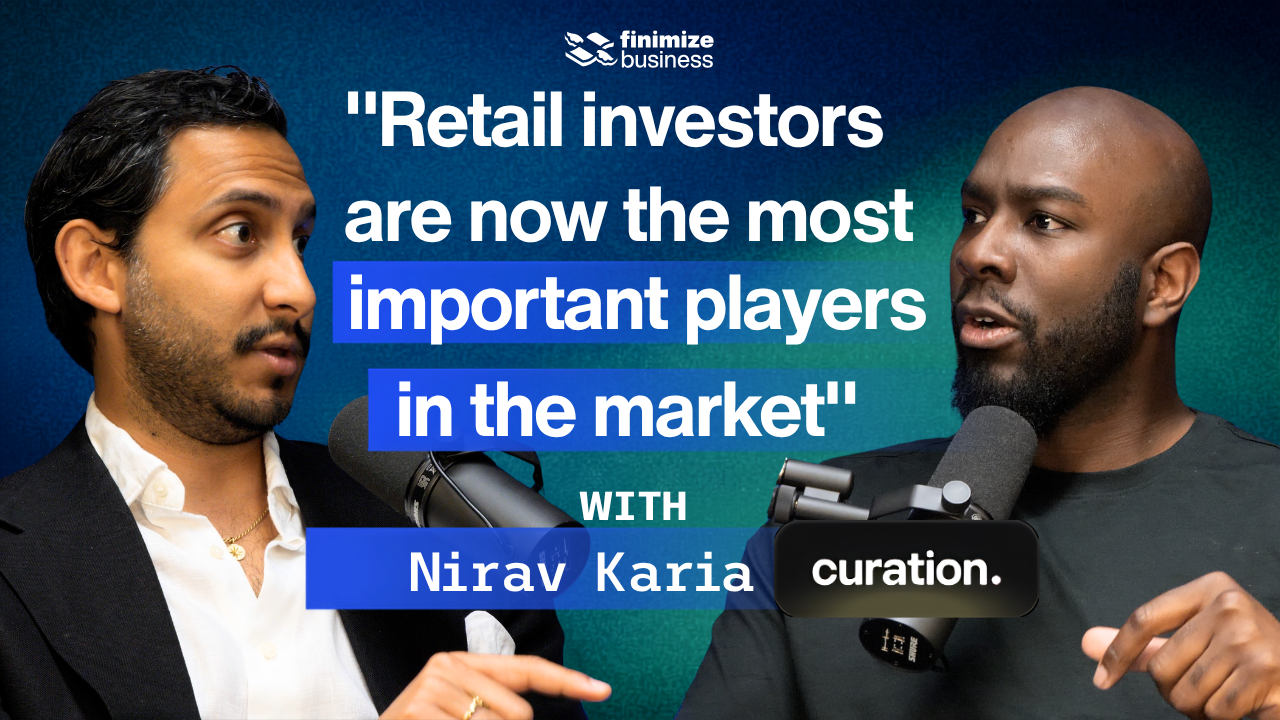
Recently, Finimize CEO Carl Hazeley sat down with Nirav Karia, co-founder and CEO of Curation, the AI-powered platform helping public companies attract, engage, and measure a retail investor audience.
Nirav has spent the last five years building a community of former and current professional investors representing north of $250 billion in assets, and his insights are absolutely relevant to anyone responsible for communicating an equity story.
Why retail can't be ignored
As of late 2025, Goldman Sachs data put retail ownership of US equities at 38% in direct single-stock holdings. Once you factor in the passive and active institutional split, retail, Nirav pointed out, now represents a larger net buyer of shares than active institutional capital. With SpaceX’s recent mega IPO and Anthropic and OpenAI expected to follow soon, the competition for retail attention is only going to intensify.
The format problem nobody's fixed
As Nirav sees it, investment research hasn't meaningfully changed in over 40 years – but the way consumers engage with content has transformed completely. And the companies that attract retail attention are the ones that treat their equity story with the same discipline they'd bring to a consumer marketing campaign.
What good looks like
Most companies aren't there yet – but those that commit to a consistent retail investor communication strategy are seeing real results.
Nirav pointed to Seraphim Space as a standout example: a company that raised the bulk of a recent capital round from retail investors by communicating proactively and consistently with self-directed investors, showing how a deliberate approach to retail engagement can turn attention into real money.
Trust is built, not assumed
Retail investors respond to being spoken to directly and honestly, but building that relationship means doing things that don't scale – at first.
"No one in this industry has actually asked, ‘what does the everyday investor need?’” Nirav said. “If you do that, you build communities, you build trust with retail investors, and you create a deeper level of engagement." In practice, that means presenting the bull case and the bear case, turning dense disclosures into plain-language content, and communicating regularly, not just at results season. Consistent dialogue, genuine transparency about risk and returns, and treating shareholders with the same care you'd give a consumer – that's what earns long-term retail loyalty.
Retail isn't dumb money
Yono Assia, CEO of eToro, has said retail investors may be the smartest in the market. And there’s a lot of real-world evidence that he’s right – from responding to White House tweets within 15 minutes during the Iran conflict to the sophistication of the GameStop short squeeze.
For Assia, it’s the democratisation of tools that is boosting investor intelligence. Self-directed investors are building algorithms, sharing research, and accessing institutional-grade data in ways that were unthinkable a decade ago – and AI is accelerating all of it.
Investor intelligence is a theme that both Carl and Nirav regularly returned to throughout their talk – and capitalizing on that intelligence has real advantages. In other words, if you build an educated, engaged, and loyal retail base, the structural advantages – lower cost of capital, improved liquidity, and a natural defense against activist investors – will follow.
Grow your business
with Finimize
Our Partners



Video transcript
Carl: Retail are no longer on the periphery. We're now the biggest and potentially the most important players in the market. When you have a disruption like the Iran conflict and there's massive sell-offs and massive rallies day in day out, people don't know what to do and they sit on their hands. That's not an investor problem. That's an industry problem.
Retail now own 38% of the US stock market. Let me put that in perspective. That's not 401ks. That's not ETFs. That's not index trackers. That is single stock direct ownership. He's actually hitting the radar of younger, savvy investors. Why not start to take advantage and harness that potential? The time is right now.
My guest today is Nirav Karia, co-founder and CEO of Curation. Curation is a platform that wants to transform how equity stories are told to retail investors. Tell us a little bit more about the platform – but also about your journey and how you've come to start and run it.
Nirav: Thank you. Curation's goal is ultimately to help retail investors make better informed investment decisions. That's been my mission from day one. We think that the responsibility largely lies with companies – the ones that are looking for investors. And actually there is a structural change in capital markets. We have traditionally been speaking and pointing our attention towards institutions, but retail are no longer on the periphery. We're now the biggest and potentially the most important players in the market. Curation's job is to help companies unlock the power of retail – to attract, engage, and measure the impact of a retail investor strategy. And when you get these three things right, the beneficiaries are both the companies themselves and the retail investors.
Carl: It's interesting, right? You said retail's becoming mainstream. Just to pull a few stats out: in the US, something like 40% of stock trading volume, 60% of options volume. In the UK, that's 20%, give or take 5% on a given day. It's a big part of the mix now. In the conversations you're having with companies – how are they responding to that? Do they care? Do they care enough?
Nirav: Well, some of the key stats I think are really important: Goldman Sachs ran a survey at the end of 2025 – retail now own 38% of the US stock market. Let me put that in perspective. That's not 401ks. That's not ETFs. That's not index trackers. That is single stock direct ownership. So retail own 40% of the US equity market. Let's look at the other 60%. Roughly, it's 30% passive and 30% active. So what we're saying to corporates is: retail now represent a bigger net buyer of shares than active institutional capital. And actually you're pointing 90% plus of your attention towards institutions and less than 10% towards retail. That has to change – and is changing.
Carl: So the wrong audience, frankly, if you're a corporate.
Nirav: Correct. And we live in an attention-driven economy. What we've seen over the last 5 to 10 years is the Mag 7 dominating attention, headlines, and therefore capital flows. Now we've got SpaceX's IPO coming up. Anthropic's IPO coming up. OpenAI's IPO coming up. This problem is only going to become more exacerbated as three of the biggest companies in the world will start to suck all the oxygen out of capital markets – especially away from companies that aren't doing anything to really address this.
Carl: Completely. And you know, Finimize is on a similar mission – helping investors make more informed decisions. Not to go too far down the rabbit hole here, but I wonder if you've got a view on the way research is done for retail investors. You've talked about SpaceX, OpenAI, Anthropic.
Nirav: Go back 15 years – it was the Facebook IPO, back when it was still called Facebook. Fast forward a little bit, it was the Post Office IPO in the UK. Then and now, despite retail being such a bigger part of the mix, research hasn't – in my view – adapted in the mainstream. Whether it's sponsored research or institutional from the banks, it's still PDFs, still jargon. I wouldn't call it nonsense – it's high-value stuff – but it's inaccessible. And because it's inaccessible, it's not going to be read, and it's not going to help anyone.
Traditional research hasn't changed in the way it's been presented in over 40 years. But the way we as consumers consume content has changed beyond recognition. We stream everything – sports, TV, movies, books, games – it's all been aggregated and streamed. But why not our financial services content? There is a huge unlock there for companies at the cutting edge of doing this.
And I would add – this industry has had a habit of using intellectual superiority to keep others out and justify charging higher fees. That's why you've seen jargon-heavy prospectuses, sell-side research stuck largely in institutional circulation. But the frameworks and the doors are opening for retail. What I loved to see was the FCA last year putting out its five-step plan, which actually had retail at the top of its agenda – drastically reducing red tape around investment advice and the level of disclosures required. These are catalysts that are a massive unlock for those that choose to take advantage.
Carl: With a cynical hat on – action matters more than words. Until we see it in practice, hard to get too excited. But it's an important signal to companies, to investor relations teams, to the asset managers we speak to: you're running out of excuses to not do this. It's easy to fall back and say "we can't do this" or "we're not allowed to do this."
Nirav: Right. And look – I think too much blame gets put on corporates, investor relations teams, and players in the industry for not having spoken to retail or put enough time and attention there. But you can understand it. They've traditionally had complex regulation and opaque guidance on how to speak to retail. And frankly, it's been really difficult to measure the effectiveness and return on investment of spending time addressing retail. It's very easy to walk into Fidelity's offices, pitch your stock, and find out the next day if they bought $5 million worth of your shares. It's not that easy to understand the impact of a capital markets day for retail.
But that has changed. We live in a digital world now where all those things are very addressable – and at a very reasonable price point.
Carl: I think a couple of things indicate how far there is still to go. Technology has jumped ahead of the institutions. Historically – the last big innovation I remember in investment research on the institutional side was HTML5. Normally the firms try to do something, maybe build the technology. At Goldman there was something called SecDB – a securities database with every single asset, every analyst forecast. A massive asset the company built because the technology didn't exist. That's sort of how innovation in financial services was assumed to happen. But we're now in a place where technology has run far ahead of where the institutions are. There are ways to track retail flows almost in the same way that Bloomberg's IOA lets you see flows in a single share – you can do that down to the broker level.
And the model you talked about has to change. Curation's changing it. I quite like to say – and regular listeners will remember this – financial services investment research takes medium-level complicated stuff, simplifies it so analysts can understand it, then makes it really complicated again so you can sell your research and make a margin.
Nirav: Right. We find joy in just doing the first bit. There's no need to dress it up and make a margin.
Carl: Look, fundamentally, I think people get paid to look clever and make themselves look clever. But Nick and I started the business as an investment club pitching to Nick's Rolodex of fund managers and asset managers. And the one thing I learned from building this community for five years is: it doesn't matter how sophisticated you are, it doesn't matter how wealthy you are – you all appreciate being spoken to in a simple way that grabs your attention. That was the genesis for our business. And I think it applies to anyone. It's fundamental content law: tell me why I care upfront, then give me the information I need to go off and do my own research. Everyone has their own research processes – we're trying to overlay an institutional approach onto the everyday investor. But there's no one size fits all for retail investors.
Attention is the first step of this journey. How do I capture someone's attention? Why do you, Mr. Corporate, deserve to have my attention in the first place? Then give me the information I need and let me go off and do my own homework. The problem we're both solving starts at the very beginning of that journey.
Carl: So you talked a little about the club and Nick's Rolodex. Maybe let's take a step back – how did you guys meet? How did the club start? And what does Curation look like now?
Nirav: My previous job was helping a UK fintech unicorn list on the New York Stock Exchange. That really fired my passion for markets. Nick and I met in early 2021 when the COVID bull market was going bonkers. Nick's Rolodex of contacts from his career were interested in coming together and talking about stocks and shares. So I spent three years with Nick building this community – a community of very successful, very sophisticated ex and current professional investors. That community now represents north of $250 billion in assets collectively, which gives us a very good breadth of expertise across global equities.
The most interesting thing I learned in this process: it doesn't matter who you are – you could be super sophisticated, or you could be a high net worth who sold their vineyard and is starting to dabble in the stock market. Everyone deserves to be spoken to with the same level of attention, care, and simplicity – because you've got to grasp my attention.
So when we were pitching stocks to this community, my job was to make videos – cartoon videos on YouTube – to portray these equity stories. And what happened was the community loved them so much, they said: "Can you help us make these for ourselves and our community? We'd love it if these companies had a strategy to get their story out to the rest of the market." Because the last time I checked, a stock price only goes up if someone else buys it after you – marginal buyers. That's really where the genesis came from: can I get this amazing information out to my generation, who have been asking me for stock tips since early 2021? Can we do it in a way that captures their attention? And can we actually get the companies to foot the bill – so that retail doesn't have to pay for access to high-quality information to make better informed investment decisions? That was really the genesis of Curation's new venture.
Carl: Can we spend a bit of time on community? You've built this really exciting community – $250 billion under management. Finimize has spent time building our own community, and we've got a million people all around the world. I've spent time in earlier podcasts explaining what everyone gets wrong about building a community. I'd love your perspective. My biggest single takeaway from building a community – the thing that really turbocharged it – was the idea that there's no single guru. Lots of people in the industry like to say, "I'm the smartest person in the room" – especially hedge managers whose businesses are dependent on being able to outperform the markets. But what we learned was: if you take the approach that the collective wisdom of the crowd is really powerful, and your crowd actually has a lot of experience and quite a high level of sophistication, the alpha you can generate is really powerful. The biggest unlock is no one saying "this is me – I'm the best at this." It's: can you unlock the power of the crowd? And that's what's led to a very powerful community feel.
Nirav: How do you think about trust – building trust within the community, but also with Curation? Does it come down to that no-gurus thing or is there some other secret sauce?
What I think is really important in our industry is putting your hands up and owning things when things go wrong. We all want to take credit when you put a really good idea in the room and make a lot of money. But transparency is crucial – being able to stand by your good ideas when it's not going the way you expected, or owning it when you think your thesis has changed for a material reason. That's been the biggest source of trust building.
Carl: Fantastic. I think that's a massive lesson for anyone in the industry watching this. My recent big bugbear – just to get on a soapbox for a minute – you might know this, we survey our members quarterly. Last quarter, the area where most people said "I want to invest here but I don't feel confident enough" was stocks. Plain old garden variety stocks – which in the US are 40% owned by retail investors. That's not because stocks suddenly got more complicated. It's because there's been a massive dereliction of duty by platforms, providers, and issuers. They haven't been fixing the roof while the sun is shining. They've just been resting on their laurels. And then when you have a disruption like the Iran conflict – massive sell-offs and massive rallies day in day out – people don't know what to do and they sit on their hands. That's not an investor problem. That's an industry problem.
On this point – there's some data from Winterflood, who produced a fantastic retail research report. One of the most interesting findings was: if you look at White House communications during the Iran conflict, you can track retail inflows and outflows swinging massively within a 15-minute interval of tweets from the White House.
Nirav: What does that show you? I think it shows that retail are more sophisticated than ever before; they have access to information and data to make their decisions where appropriate; and they're actively looking for those insights. I would urge all companies to look at this as an advantage and not a paranoia. Because if you can get your messaging right and put it on the right channels, you can unlock the fact that everyday investors and modern investors are there to listen and respond. Treated with clear communications, you can harness that potential.
Carl: Fantastic. The other big question on community for me is doing things that don't scale – that are painful. In the conversations we have, everyone appreciates the value of the community that's been built – no doubt. But they all want it without doing the hard yards. How have you approached that? How hard was it, when you're building a business, to do something you know doesn't scale in order to get to the point where you can?
Nirav: It's taken us five years to get to this point. Scaling is important commercially – but actually for building a community, intimacy is what's important. We speak to every single one of our members on a very regular basis. We give them a channel to speak to each other, and we take on their feedback and build tools and products that they ask for.
This comes to a point in the industry that really frustrates me – especially in the retail space. What's traditionally happened is that players come into the retail investor industry straight out of an investment banking role and say, "I know how to tell equity stories – I'll transpose my experience straight onto the retail investor." But no one in this industry – apart from Finimize, by the way, who've been doing this for 10 years – has actually asked: what does the everyday investor need? What are they asking for? Can we build a product from the ground up based on what they're asking for, that actually serves their needs first? If you do that, you build communities, you build trust with retail investors, and you create a deeper level of engagement. The end results are far better for every other player in the industry.
That's why in my view most of the existing retail products and retail offerings in the marketplace today have failed – and failed to deliver attribution, which is the one thing companies are asking for. Because the way they've been built has been built from the wrong end. Build it from the ground up. My team and I have spent 2,000 hours of interviews with retail investors going: what do you need? What's wrong? How could you be better served to access this information?
Carl: I completely agree. And just to share in your frustration – we've done the work to understand that this is something that can be solved, and we have a view on how to solve it. I find it incredibly frustrating when I'm in a room or on a panel and other panelists are saying "we've built these products for retail but they are too this or too that." I'm like – they are not the problem. You are. You're coming at this all wrong. You've been pushing against a shut door for decades and you're complaining the door's still shut. Try pulling. It's a pull door, not a push.
One of the biggest frustrations for me was seeing – a win, actually – that we put together a retail investment task force that was in Whitehall earlier this year. The frustration: every single person around that table was the C-suite of some of the biggest asset managers and institutional players in the market. Can we not involve some of the players that actually get it? That speak to retail on a regular basis, and are retail investors themselves?
Nirav: I can completely see that. In a world where track record is so important – it just doesn't make sense that the people with the track record are not being invited in to shape the policy and the direction of travel.
Just to zoom out from our respective communities to the wider retail investor community – they get called dumb money. Thankfully less than they used to. But there's tons of evidence that they're actually smart money. Can you share a bit about what you've seen and learned?
Carl: One great example: the CEO of eToro recently said that retail investors might be the smartest investors in the market. We've touched on the Winterflood data that shows retail can respond within minutes of material news flow.
A great example I think we should talk about is meme stock mania. Retail get cast in a bad light because of it. But I actually think it shows a more sophisticated side to retail investors than anyone has really considered. The whole hypothesis around the short squeeze was retail investors saying: "There's the smart money – there are the institutions shorting our favorite companies, our favorite brands, brands we want to be around for a long time. What can we do about this?" And they actually took the sophisticated approach of coming together as a community to short-squeeze those institutions. If that doesn't show quite a high degree of intricate market understanding and sophistication, I don't know what does. And secondly, it shows that they figured out a way of using tools, technology, and forums to come together as one community to achieve an end goal – in this case, to short-squeeze the hedge funds and support the companies they love.
A lot of companies ask me: "I'm worried about the volatility retail can create in my stock – are they going to pump and dump? Are they meme-stock crazy?" I actually think this shows an unlock. We know retail has bought every single dip in the last five years, and has actually been right to do so – the returns have outperformed a lot of the institutional guys that just conform to the mean. Imagine if you're a corporate: you can harness the fact that in today's digital age, you can build your own communities and build your own long-term resilient investor base that actually wants to champion your long-term efforts.
The biggest thing about having a retail strategy is – yes, it's a corporate governance issue, and it is your fiduciary responsibility to speak to all your investors and potential investors with the same level of information. But more importantly, this can lower your cost of capital. There are many case studies that prove retail can help improve liquidity, especially in UK capital markets that desperately requires it – and the impact that can have on your enterprise value and valuation.
Nirav: That fundamental value point is a real one. We saw it with GameStop and AMC. Whether or not you buy into the sophistication of retail buying those stocks – it did happen. Those companies were able to transfer a pop in their share price into an opportunity to issue shares and raise capital that then transformed the fundamentals of the business. Real-world impact.
Can we talk about a recent UK example? Seraphim Space – we're fortunate and very privileged that they're a client of ours. Look at the amazing results they had raising money from UK capital markets. The bulk of their money was raised from retail investors. Yes, they capitalized on space being a very hot topic – but they've been very vocal and very strong in communicating to retail. The retail book raise was a brilliant example of how to take advantage of building a very loyal retail investor base. It is possible – and it's possible in the UK, not just the US.
Carl: Fantastic. And the other benefit there – detractors will talk about the risk of retail volatility. But the other side of that coin is activist investors. A strong, diversified retail base who are engaged and will vote their shares is actually a pretty good defense against activists who themselves cause volatility and all manner of issues.
Nirav: And look at what Saba is doing in the investment trust space.
Carl: I didn't want to mention it, but now we're there.
Nirav: We are there. And investment trusts – where do we start? Investment trusts are a perfect vehicle for retail. They give retail access to companies they otherwise potentially wouldn't have access to, in a diversified way. And by the way, you can buy them for 70 cents on the dollar. Have you ever wanted to turn down buying a dollar for 70 cents?
Carl: Not in this environment.
Nirav: Right. So they are a perfect vehicle. The issue has been that retail investors haven't had the ability to participate in voting. And activist investors like Saba have taken advantage of that. What we're seeing – and it's really sad – is that investment trusts are now under massive attack. I hope and think the AIC and the rest of the investment trust sector are actively looking at ways to do demand generation rather than just buying back shares, to support the wider space.
Nirav: It'd be great to see some more regulatory or government-level support for what is, I think, a brilliant product for retail investors. Just to add – because I read it this morning: 25 to 34 year olds in the UK are twice as likely to buy an investment trust in the next six months compared to all other investors. So what you're seeing is a product that's typically been seen as boring and stuffy – something your grandparents might own – actually hitting the radar of younger, savvy investors. Why not start to take advantage and harness that potential? The time is right now.
Carl: Let's get into how Curation does what it does. You started with videos – companies said "make this for us," investors said "we want more, we want companies to be proactive." What does that process look like today when you walk into a room with a company?
Nirav: Curation's role is really to bridge a gap between companies and retail investors. We give corporates the AI infrastructure to help them communicate with retail at scale. In practice: I want to help companies attract new investors, engage those investors, measure whether that's actually working – which no one else has tangibly done in the industry – and lastly, retain retail investors over the long term. So our job currently starts with: can we help you present your equity story in a jargon-free, digestible way that's transparent around the bull case and the bear case? Because transparency lends integrity to your story.
Can we turn your public disclosures into content that retail investors actually want to engage with? Can we do that in a seamless way that takes no lift from the company? And can we take all of that content and get it in front of retail investors at scale? Once we've built your audience, can we then nurture them over the long term with the messaging and communication you want to deliver? And we try to do all of this at an affordable price point that takes no lift from investor relations teams.
Carl: And then that measurement piece – which you talked about being really hard historically. Maybe talk about the challenge and how you've started to solve it.
Nirav: Historically the problem is: if I invite 100 retail investors into an AGM, how do I measure whether that has any tangible return on investment? But we now live in a digital world, and what Curation has managed to unlock for corporates is the ability to track layers of engagement, audience size, and whether that translates into improved trading volume, improved liquidity – and ultimately whether that translates to improved share price performance. We've found that when companies work with us and implement an effective retail strategy, over a three-to-six-month-plus period, you can tangibly deliver uplifts in trading volume and specifically attract net new marginal buyers.
Carl: Who does this well?
Nirav: There are varying degrees of retail success. Companies get scared of what they can and can't do. But a really tangible example: L'Oreal puts a four-page spread every quarter in the Wall Street Journal, Barron's, and the Financial Times – on their quarterly results. That's an example of advertising your equity story. And by the way, publicly listed companies are the only businesses that advertise once a quarter. You wouldn't advertise your product once a quarter if you ran a business. We do that with our equity story. The important thing to actually unlock the power of retail – who are consumers at the end of the day, just consuming your equity story not just your product – is to have that regular, constant dialogue and communication that builds trust, transparency, and nurtures that audience.
You know who does that really well? Anthropic – a private company, for now at least. Every sprint, because they've got a million Claude agents running, there is a new product release, a new feature, a new video. They're telling the story of: this is how Claude can help you, this is what Claude can do now, this is the new tool. Claude for wealth, Claude for finance, Claude for lawyers. And as a user of Claude, every week I'm like – these guys are on it. I am bought into the way they build their product. Anytime someone from Anthropic is on a podcast being interviewed, I go out of my way to download it, watch it, and listen to it.
Nirav: And so when the IPO comes along, I have no clue how the numbers are going to look. Frankly, I don't think anyone does. But I'm going to be a hell of a lot more interested than I would be in another AI company.
Carl: Can we name and shame?
Nirav: Go on.
Carl: Can I give you an example of someone that doesn't do it very well?
Nirav: You going to say OpenAI?
Carl: No. Going back to public companies – name and shame one that does a brilliant job overall but has an example of a strategy that I don't think is particularly well thought through.
Nirav: Qualcomm sponsors Manchester United. Manchester United is one of the most followed football clubs in the world, and they spend tens if not hundreds of millions on that sponsorship. But on the Manchester United shirt, it says Snapdragon.
Carl: Yes.
Nirav: Who knows what Snapdragon is?
Carl: Remarkably – I made my last PC choice based on it having a Snapdragon processor. Not because of Man United – just because of the product. Whether it was a Qualcomm product or not was a buy factor.
Nirav: You're an edge case and you just undermined my point. But this goes back to – imagine if the shirt said "Snapdragon by Qualcomm."
Carl: I bought the computer. I didn't buy Qualcomm shares. If it said Qualcomm on it, I might have bought the stock.
Nirav: And so what we're finding in the retail investor space is that investor relations budgets – which have traditionally been held quite constrained by CFOs and finance teams, quite rightly – are now starting to be intertwined with companies' marketing budgets. Which makes a lot of sense. And come back to a company we admire a lot in this space: Stock Perks. Everyone should be doing this – loyalty for your shareholders. If I own shares in BA, why don't you offer me speedy boarding when I go to board my plane? Reward me over the long term for being a shareholder. This is something Stock Perks does brilliantly, and I think it's an amazing way to loop in the marketing world, the loyalty world, and actually build long-term, sustainable shareholder bases.
Carl: I love that idea. It's the idea that your customers can be your shareholders and your shareholders can be your customers – a virtuous circle that can be unlocked. As a shareholder, I'd love it if Apple invited me to a special event once in a while. Most of the stocks I own are consumer names because I know what those companies do, I know the brands. And that takes you back to the whole question of: why should I be speaking to retail and informing them on what I do? Build that relationship and they will be long-term shareholders.
I want to ask you one thing before I let you go – what's the most ridiculous or funny financial news story you've seen in the last few weeks?
Nirav: There are two I've got to flag. First: in Q1 this year, Coinbase's CEO was presenting their earnings results – and while he did so, he played Subway Surfers throughout the earnings release.
Carl: How do you know that?
Nirav: I think it was released to their employees and then obviously leaked. This captured my interest because it was a TikTok trend at the time – you know, spill out some information to camera while playing something almost like brain rot video to capture people's attention. What I think this demonstrates is there's a fine line between entertainment and educating responsibly. However, there are ways to think about being unique and novel and capturing the attention of a very different audience. I thought that was super cool.
The second thing that hit my attention last week – and I think it's an amazing way to round off what we've spoken about – is that SpaceX, perhaps the most important company in the world today and about to IPO, recently put out a job advertisement for an investor relations team member. I looked at that job description, and one of the most important skill sets it requested was social media expertise.
Carl: That's interesting for two reasons. One, it makes the point we've been talking about all along – engaging investors, retail investors. The other point it makes: doesn't Elon's X already have the social media expertise, being plugged into Twitter?
Nirav: 100%. But what I think – and I don't know if you want this in the podcast – there's also a company that just put out a job description for a new investor relations officer, and it didn't have a requirement for social media expertise.
Carl: I for one am shocked.
Nirav: What I think this shows is a clear example of what good looks like – and the benefits that are attributed to companies that actually implement a retail strategy.
Carl: And actually what I'd like to end on is this: this is the biggest dislocation I've ever seen in financial markets. And the opportunity is so clearly there for the companies and players that choose to embrace and unlock the power of retail.
Nirav: That's a perfect ending. Nirav Karia – thank you so much for joining me.
Carl: Thanks, buddy.