
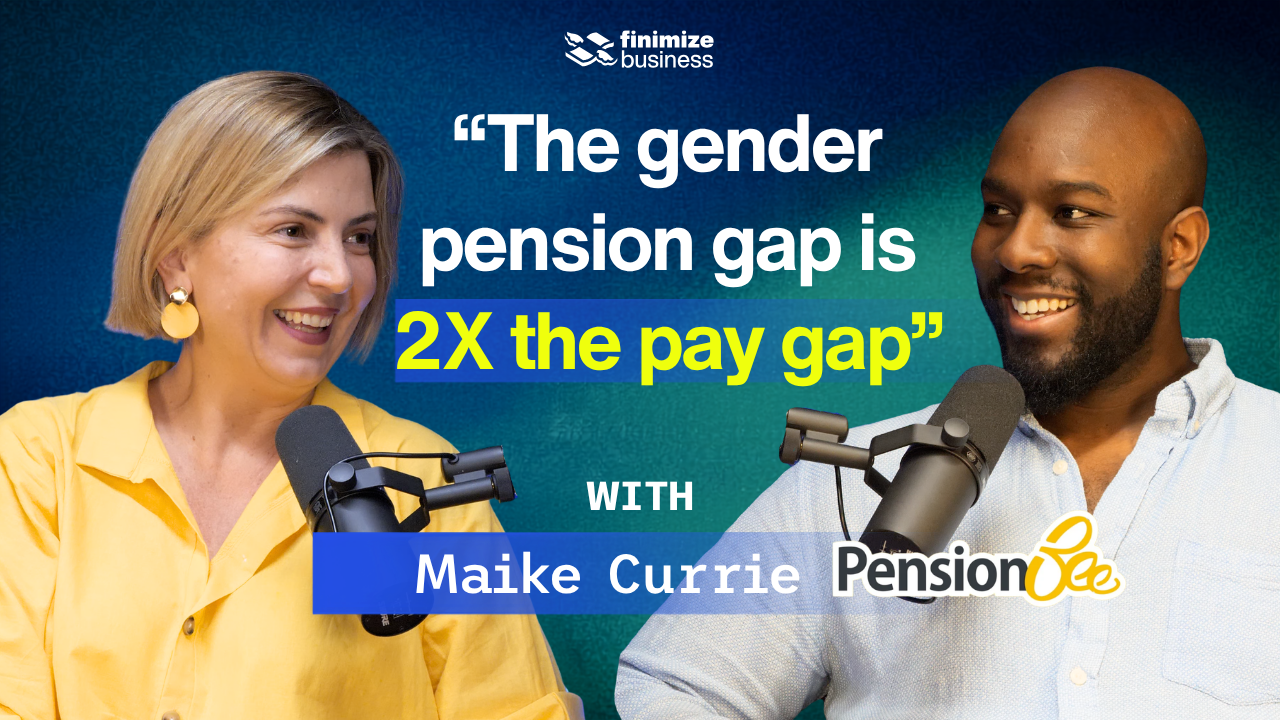
Finimize CEO Carl Hazeley sat down with Maike Currie, VP of Personal Finance at PensionBee, to unpack the UK's £100,000 gender pension gap, why pensions deserve top billing over ISAs as the on-ramp to investing, and what good pension marketing actually looks like.
Drawing on a career spanning journalism, asset management, and marketing leadership at Fidelity International and Hargreaves Lansdown, Currie makes the case for outcome-led, jargon-free messaging, an end to "pink-washed" products aimed at women, and policy reform for the self-employed and "invisible workers" currently locked out of auto-enrollment.
Why the gender pension gap dwarfs the pay gap
The gender pay gap gets the headlines – but the gender pension gap is roughly twice its size.
"Most women, when they reach their 50s, will, on average, have around £100,000 less in their pension pot than their male counterparts, and it's then very difficult to close that gap," says Currie.
And that’s not down to just pay alone, says Currie. Women are more likely than men to step away from work to raise children, and when they return, they face what she calls the "motherhood penalty" – a hit to promotions, pay rises, and pension contributions. Just to rub a little salt in the wound, that sits in direct opposition to the "fatherhood bonus" men often get instead.
Plus, later in life, many women face suffer what Currie calls the "good-daughter penalty" – supporting children still living at home while also caring for aging parents. Women falling into "that sandwich generation” are squeezed, says Currie, “just at the time when they should be putting everything they can into their pension."
Pensions, not ISAs, are the real on-ramp to investing
Currie's central pitch to the industry – and to government – is that pensions, not ISAs, are the most powerful tool for turning non-investors into investors. And the simple reason is that most people already have one.
"The key to getting people to engage with investing is to plant the seed, or drop the bombshell, that their pension is invested in the stock market," she says. In her talks, she says, that’s her “mic-drop moment”. Often, when she asks her audiences who considers themselves an investor, only a few hands go up. She then asks who has a workplace pension – most hands go up. "And then my line is, ‘Well, you are an investor, because that pension is invested in the stock market.’"
Her challenge to the next chancellor: stop tinkering with ISA allowances and instead lean into pensions as long-term, compounding investment vehicles that people already hold – then market them that way.
No pink ISAs: what good pension marketing looks like
Currie was blunt about the industry's most common misstep in trying to reach women: cosmetic rebranding instead of substantive change. "That's an age-old trick of marketers... Women don't need a pink product, a pink ISA, a pension wrapped in a pink bow."
Instead, she argued for outcome-led, jargon-free communication that connects pensions to real life – asking people what they want to do "one day when they stop work," rather than leading with the word "retirement." "We've got to relate to people in a way that engages them – hearts and minds," she says.
The real competitor isn't another pension provider – it's Netflix
Currie is currently VP of personal finance at PensionBee, the pensions consolidator. But their biggest rival isn't a legacy workplace pension provider – it's every other app fighting for a slot on someone's home screen.
“We're competing with Netflix, competing for people's attention, Currie says. "That's the biggest, that's the first challenge, because inertia is the default." Getting people to act at all, she argued, matters as much as getting them to act correctly – which is why breadcrumbs like vox pops, relatable language, and peer conversation do more to move people than another compliance-approved fact sheet.
Fixing the policy gaps: the self-employed and "invisible workers"
Auto-enrollment has driven up participation, Currie says, but it was built around payroll – leaving the self-employed and gig economy workers with no equivalent nudge. PensionBee is lobbying for auto-enrollment to be linked to self-assessment, so that submitting a tax return triggers a simple prompt: have you put something into your pension?
She also flags a structural gap for what she calls "invisible workers" – people on zero-hour contracts or under the £10,000 auto-enrollment earnings threshold – who fall outside the system entirely. "There's a risk that there's a whole generation left behind with not enough pension," she warned, alongside a state pension that, even at full entitlement, leaves little room for comfort.
On ISA tinkering: complexity is the enemy of engagement
Currie's biggest bugbear of the moment: repeated changes to ISA allowances and rules, including new complexity around cash-like holdings inside stocks and shares ISAs. "It's like taking a really beautiful, simple vehicle and over-complicating and over-engineering it," she says – and every rule change chips away at trust. Her advice to policymakers and providers alike is what underpins PensionBee's own proposition: don't over-complicate it, make it easy, and stop changing the rules.
Grow your business
with Finimize
Our Partners



Episode transcript
Carl: Welcome to Retail Investors Decoded, a new podcast by Finimize for Business. We'll be speaking to leaders across the financial services industry about how to attract, retain and engage modern investors. My guest today is Maike Currie, VP of Personal Finance at PensionBee, author, and one of the UK's preeminent voices on retail investing, pensions and financial education. Maike, before joining PensionBee you wrote a book called The Search for Income. You've worked across asset managers and in journalism – excited to get into all of that with you. So first of all, thank you for joining me.
Maike: Thanks so much for having me, Carl. I'm really excited to be here.
Carl: Awesome. I'd love to start with that journey, because I find it so interesting when people have gone in a few different directions before landing where they have. Talk me through it – you started as a journalist, you've worked at a handful of asset managers, now you're at PensionBee. How did you get here?
Maike: Yes, it has been quite a journey. I started my career as a journalist at a daily newspaper in South Africa, covering economics and business. It was a great place to learn – to frame conversations and write articles at breakneck speed; it was a daily newspaper. I then moved over to the UK, which is now twenty years ago – I can't believe it. It was before the 2008 financial crisis, and I was working for a number of titles within the FT group. First it was a publication targeted at advisers, FT Adviser, which was a really good place to build my knowledge of the whole landscape and the conversations advisers were having with their clients. Then I moved to Investors Chronicle, which was brilliant – I covered personal finance, funds, investment trusts, and also did a lot of company writing on that side.
I then decided I was going to go across the river, to the "dark side" as they might call it – or the better-paying side – and started working for asset managers. I worked for Investec Asset Management, which is now Ninety One. That was a big transition, going from journalist to the corporate world, but I always missed working with a direct consumer – a retail investor, or as we say, the investor – because the challenge there is really creating content, creating conversations, making sure you get that person on the street to engage with their investments, their ISA, their pension.
That led me to the platforms, the DIY platforms. I spent a number of years at Fidelity International for their personal investing business – we had a lot of fun there, created a lot of content, worked with the media. Then Hargreaves Lansdown approached me and asked if I wanted to come down to Bristol and work for them. I spent almost three years at Hargreaves Lansdown, again in the marketing department, creating content and doing a big drive on engaging women – Hargreaves at the time had around 600,000 women investors. Now I'm back in London, in yellow, working for PensionBee – really talking about pensions as the ultimate vehicle to drive engagement with investing.
Carl: Fantastic – lots there we're going to unpack. I want to touch on a couple of things first. I always ask journalists who've crossed the river this question: is there an inherent tension where, as a journalist, you're truth-first – finding the facts, presenting the information, making the case – versus doing that for an institution, where there's a bottom line to think about that's perhaps at odds with your journalistic instincts? How did you square that circle, and how do you continue to square it?
Maike: It's a really interesting question. As a journalist it's very much about not having a bias, showing both sides – the skill set is storytelling, balance, finding the angle. I've used those skills, honed over many years, in creating content for organisations. The principles still apply: people don't want a line fed to them by a company, they want something engaging and entertaining that they can relate to. I always say we talk about "personal finance," but the clue's in the word – it's about the personal. If you can create content and conversations that are engaging, that's what makes the difference. On the commercial tension – yes, it exists, but it's a good skill to learn too, because as a journalist you think about the angle, the story, the exclusive, but there's a commercial benefit as well. I think I've benefited from being on both sides and using those skills on both sides.
Carl: And the other thing to pick up on – what's the unique perspective and insight that led you to the nucleus of the book idea? How did you get there?
Maike: The first thing to say is when I wrote that book, I didn't have children, so I had a lot more time. I was working at Investors Chronicle, and it was post the 2008 financial crisis – interest rates had gone to rock bottom and everyone was desperate to find yield, to find income. That was the angle of the book. It was interesting because at the time no one thought interest rates would stay so low for so long.
Carl: I missed that.
Maike: I know – that was really the time to be getting onto the property ladder and all of that. But for me it was, one, I had the time; two, it was a really good exercise in getting my head around income-generating investments. I still think we're in an era of an ageing population, living longer, who need income-generating assets. It was a good thing to do, I built my knowledge – of course the world of products, funds and investments moves on so quickly that if someone read the book now they'd say, "the ISA allowance has gone up a bit since you wrote this, Maike."
Carl: Well, when your publisher gets in touch for the updated version, I'll be in touch with my commission. Let's jump forward a little – I want to combine a couple of things you mentioned: speaking to women, and where you are now at PensionBee. Is there still a pensions gap as far as women are concerned? How big an issue is it?
Maike: There's a massive pensions gap. To put it in context – people talk about the gender pay gap a lot, and it gets a lot of headlines, rightly so. But the gender pension gap – despite it having been illegal since the 1970 Equal Pay Act to pay men and women differently for doing the same job, the gender pay gap still exists, and depending on the industry it's around 18%. The gender pension gap is twice the size of the gender pay gap.
People often ask, is the gender pension gap because of the gender pay gap? Yes, the pay gap plays a compounding role, but by far the biggest contributing factor to the gender pension gap is career breaks – the fact that women's careers are different, and women are more than likely, over a lifetime, to take a career break, either to raise a family, because biology dictates women have babies – and even though caring should be shared, women will take that break. We often see the gender pension gap widen in the childbearing years, which increasingly is later, so in their mid-30s.
Then, when women come back after those years raising children, getting back in their 40s or early 50s with all that experience, there's what I'd call a second penalty – I often talk about the "motherhood penalty." People get upset about that term because they think, "motherhood is a privilege" – of course it is, but the penalty still exists. It's not a term I coined; it was coined by sociologists, and it describes the impact having children has on your career trajectory, your chances of promotion, your chances of a pay rise, and crucially your pension. It stands in direct opposition to the "fatherhood bonus" – when men have children, society and workplaces say, "he's a dad now, maybe we should give him a pay rise, he's more responsible, possibly a promotion." So the motherhood penalty is real.
Carl: I'm going to take that to the board.
Maike: We'll have that conversation. And then in your late 40s and 50s, with all that experience, there's what I call the "good daughter penalty." You find yourself with adult children at home who, as we know, are struggling to get a foot on the property ladder, struggling with job prospects and the cost of living – so a lot of people have adult children at home, and at the same time an older generation who need care. More often than not, rightly or wrongly, it falls to the daughter. So it's that sandwich generation squeezing women just at the time they should be putting everything they can into their pension.
Carl: People having children later in life is a current phenomenon – but bringing all that together, what's your sense of the direction of travel? Getting worse, getting better? Awareness feels like it's improving, but where are we?
Maike: It's a good question. Awareness is improving – there are more conversations about it, more money influencers, more conversations about money generally, which is a positive. The reality, though, is that most women, by their 50s, will have on average around £100,000 less in their pension pot than their male counterparts. And it's then very difficult to close that gap.
Carl: Gotcha. So here's the million-dollar question – we've identified the problem, awareness is improving, there's still a £100k gap to solve. Whose responsibility is it to solve? Employers? Government? Mothers, fathers? Whose job is it?
Maike: I'd say it comes down to three pillars. First, the personal – we need to talk about money, talk to our daughters about money, talk to our partners, address it from a personal perspective. More women are breadwinners now, so we need to talk to women about investing and closing the pension gap. Second, the professional – we know we're in a male-dominated industry. Like it or not, you work in financial services, I work in financial services – you walk into a room, it's still predominantly blokes. We need to see more women, and actually women start out in this industry in their 20s and then disappear – there's no pipeline. It needs to be more friendly to keep women, from a professional point of view, and to welcome them back after maternity leave, the way men come back after paternity leave – and giving men more paternity leave is a fundamental issue too.
Then there's the policy element, from government, because pensions were designed without taking into account women's career trajectories, women's lives. There are structural issues. For example – why is it that if you're out of work and someone contributes into a pension on your behalf, that amount – £2,880, plus £720 in tax relief from the government, so £3,600 a year – has stayed unchanged for many years? I often say to women, if you're not working, remember someone else can still contribute into a pension on your behalf, but it's capped at £2,880, and it's been that amount for about the twenty years I've worked in financial services.
Carl: Inflation, or the lack of it, in pension allowances is its own issue.
Maike: It hasn't even been accounted for – and let's park the triple lock for now. Carry-forward rules are a brilliant concept: if you haven't used your full pension allowance, you can carry forward unused allowances from the previous three years. But what about women who took a career break a few years before that? Policy needs to update.
I do think auto-enrolment has been a huge success in addressing participation and inertia – you're in unless you opt out, so a lot more people are saving into workplace pensions, which is good. But it hasn't addressed adequacy – we know 8% isn't enough for retirement. And it hasn't addressed the fact that the world of work has fundamentally changed. We've had digital revolutions, a pandemic, more of us working flexibly, and a lot more women choosing to be self-employed – a lot more of us generally choosing self-employment for the flexibility. But the Achilles' heel is that no one is saving into a pension for you.
Carl: And no one's coming to save you.
Maike: No one's coming to save you – you've got to set up that personal pension yourself, and we need more awareness of that. We also need to question whether auto-enrolment goes far enough – it's been designed around payroll, and most of us aren't necessarily employed through payroll anymore. So one proposal PensionBee has put forward, and is lobbying hard on, is finding a way to get the self-employed into auto-enrolment by linking it to self-assessment.
Carl: So when the self-employed complete their self-assessment, there's a trigger asking whether they've put anything into a pension.
Maike: Exactly.
Carl: Playing devil's advocate – from a policy point of view, shouldn't the government simply have a different set of pension rules for women? There's a £100,000 gap, women live longer than men, so the effective need for cash is greater. I wonder if the rules should be different – say, women get ten years of catch-up on pension contributions.
Maike: It's an interesting concept – it would probably go down like a lead balloon.
Carl: That's why we get to say it here, not down the road.
Maike: But I do think what we need is policy for what we call "invisible workers." Invisible workers can be men or women – people on zero-hour contracts, people keeping the gig economy going, people doing caring work. There's a whole group keeping the economy going who, because their work is invisible, fall outside the auto-enrolment threshold. Auto-enrolment requires a minimum income of £10,000 – if you're below that, you don't get enrolled. There are plenty of policy tweaks government can and needs to make, because there's a risk of a whole generation being left behind without enough pension. The state pension age is increasing, and even the most frugal of us will struggle to live on the roughly £12,500 a year the full state pension provides now – and that's only if you get the full amount, which requires 35 years of National Insurance contributions, which many women won't have because of career breaks.
Carl: Got it. I want to shift gears and bring it closer to home – we might make some enemies here. I'm reminded of the Sky Sports TikTok account that was basically "Sky Sports Pink," trying to get women to care about football, and sport in general – making memes like turning a Ronaldo goal pink because "girls like pink." It went down like a lead balloon, people hated it, and it was scrapped quickly. What does good communication and engagement look like in this space, whether for women or pensions generally? You don't have to name names – people can put names in the comments – but what pillars have you seen work well?
Maike: The first thing to say is: definitely don't add a pink hue to anything, or a tint of pink – that's an age-old trick of marketers, thinking if they make it a bit pink, a bit feminine, women will come. Women don't need to be talked to differently. Women don't need a pink product, a pink ISA, a pension wrapped in a pink bow. What we all need is to be spoken to about outcomes. Why should I be putting money away every month? Why is compound interest so powerful? Why should I be investing? Why should I move money from a cash ISA into a stocks and shares ISA? Why should I care where my pension is invested, how much is going in, and whether it's well invested?
The way to do that is to stop talking about the technicalities. We work in the industry, we're all geeks, we love the nitty-gritty and showing off how clever we are – that doesn't help the consumer. We say "stop using jargon," but do we really mean it? If you look at pension literature, are we saying, "this bit determines how the longest holiday of your life is going to go – whether you'll be sipping piña coladas on a beach or doing part-time work in the local supermarket because you don't have enough in your pot"? That's shaking people by the shoulders a bit, but we've got to relate to people in a way that engages them – it's hearts and minds. Martin Lewis does a really good job talking about personal finance, coupons, discounts, all of that – we need that kind of Martin Lewis approach applied to investments.
Carl: Part of why I wanted to have you on, and why I think we're well aligned, is that I'm quite happy to get on a soapbox about the fact that the financial services industry, by and large, has abandoned people when it really matters. I'm a retail investor, a pension holder – and yes, I'm relatively sophisticated, but that's no thanks to my bank, my pension provider, or the government.
Maike: Exactly.
Carl: The challenge the industry has is: when it wakes up and decides, "actually, Carl's quite important, we should say something to him" – why on earth would I listen to them? Why would I listen to people who've ignored me for the first thirty years of my life, in the second thirty? That's where I think it's true of Finimize, but also true of PensionBee as a relative disruptor – even though you've been around a fair while, you're not part of the problem, so to speak. There are things I've seen PensionBee do in terms of communication and engagement that I think the rest of the industry could learn from.
Maike: Yes, I think there are two issues here. One is the proposition – if you think of the legacy providers, the propositions don't make it easy. It's not easy to open a pension or an ISA with one click. But I've always been astounded that when people do make the decision to invest and engage with a pension, how much they're willing to put up with in terms of a proposition that isn't slick, that isn't easy – phoning a call centre, sending off paper forms. Once they've made the decision, they can power through. But we're talking about a new generation that doesn't have that patience – if something's taking too long, they move on to the next provider who can give it to them instantly. That's the reality. So propositions need to improve.
But to get me to the place where I'm even considering the proposition, that's marketing – that's content and engagement, getting me, talking in a language I understand, addressing the problems I feel. And again, it's not about being clever – I do my "yellow coat" interviews and ask people what they think; I'm not telling them. I recently did vox pops in Manchester – Manchester is where it's all happening, Manchester and Birmingham. We started off asking people about pensions, and honestly, surprisingly, pensions weren't front of mind. A lot of people weren't engaged with the question at all. Then we started asking, "what do you want to do one day when you're not working?" Just framing it that way – not "what do you want to do when you retire" – because the person on the street is just trying to get through today, not thinking about retirement. But if you ask, "what do you want to do one day when you stop work – you're catching that bus, running late, but what's your dream? Talk to me about that. And do you know your pension is going to fund that?" You should lift the lid, know what's going on in there, and have conversations with your nearest and dearest about how you can get that outcome together. It's small tweaks like that.
When you actually go out on the street and talk to real people, you get a real sense of how detached they are from our world. We love our world – we find it interesting, we get obsessed with our own bits, what our competitors are doing – but really, we're operating against a backdrop where people are struggling with a cost-of-living crisis. They've had multiple crises – the pandemic, which was seismic, the war in Ukraine, now war in the Middle East, heatwaves – it feels never-ending. Against that backdrop, you've got to convince people to talk about pensions, ISAs and investments, and they're thinking, "I'm just trying to get through the day."
So it's interesting – PensionBee's philosophy, and this is the philosophy of our Chief Marketing Officer, Jasper, who's brilliant, is that we're not competing with – and I won't name them, but think of the incumbents in the pension space, the legacy workplace pension providers – we're competing with Netflix. Competing for people's attention. That's the first challenge, because inertia is the default. How do we get people to do something, but also how do we get their attention, when we're competing with Netflix and a thousand social media apps?
Carl: And you said something really powerful there, about getting someone to have the conversation. Our data shows about 40% of people who start investing do so following a conversation with someone they trust – a colleague, friend, family member – and that's consistent across age brackets, whether you started investing this year or ten years ago. So the way I think about what you've described – the vox pops – it's the breadcrumb, the thing that leads to the catalyst. The catalyst before the catalyst, I guess.
Maike: Yes, it's really interesting. A word that's often bandied about is "confidence" – people need to get confident. But what I've seen from research at multiple places is that what actually makes people feel good is this notion of control, especially against the backdrop of a mad world – things happening that are so beyond our control. But when you do one thing – consolidate your pensions, move from a cash ISA into a stocks and shares ISA, and start seeing the exponential growth the stock market can give you over the long term – you get a feeling of control, and that's really powerful. Then you want to do more, because you've actually sorted this thing out that's been at the back of your mind. I've known I needed to get my head around my pensions, known I must invest – I'm never going to be a DIY hobbyist investor, never going to sit and watch my investments, but I know I'm with a good provider, my pensions are consolidated, I'm in a ready-made fund, and it's one less thing – I've got control of that.
Especially for women – people say women need more confidence, women are risk-averse. Actually, women are already better investors than men. Women manage the purse strings, women are good with money, but the world tells them they're not. There's a narrative that women need to be "good" and saving is good, while men need to be "brave" and investing is brave. Fundamentally that's a problem, and that's why we have this challenge as a society to get people to invest – we still carry this underlying message that saving is the prudent thing to do.
Carl: Exactly on that – one of my big bugbears with the industry is when it says "it's investors who are the problem, people don't feel this, people don't know that." No – you are the problem. It's your job to get this knowledge out of your own heads, because you're sat in a room with people who understand all this stuff, and you and I could easily descend into a conversation that's all jargon and think we're being accessible because we understand each other – but the moment it leaves this room, it falls on deaf ears.
Maike: Yes.
Carl: So I agree with the solution around confidence and so on, but I think – you said it, "navel-gazing" – there's far too much inward-looking thinking.
Maike: I think there's the aspect of how we talk about investing, but there's also the question of how we bring companies that get people excited to the retail investor. There's a lot of talk about an investment campaign to bring more people into investing – is this "Tell Sid" 2.0, the next iteration? The reality is that campaign was successful because it gave people something to buy – a slice of British Gas, the company that heats their home. When you tell people they can own a slice of something they understand, that's near and dear to them, investing becomes real.
I've thought a lot about this – what's the evolution of becoming an investor, how do people start? One of the key ways is when people work for a company and get equity, a share in that company – it might be privately owned, not listed – but owning that slice gives you skin in the game. And then you see the exponential way you can grow wealth through owning a slice of a company, and it starts getting exciting – "I might hold another slice, I can actually hold a slice of Apple or Microsoft." On that point, we need companies in the UK that can get people excited. People often say all the tech giants are in the US, but – I shouldn't talk about individual stocks, but with Primark leaving AB Foods, every young person can say, "oh, Primark, I can own a slice of that." But will that come to retail investors, or will it be some clever corporate restructuring just for institutional investors? Think about the banks we use, the challenger banks, the apps – if I had the opportunity to own a slice of a brand I use every day, investing becomes real. And I'm sorry to say it, but that's part of why people got so excited about the SpaceX IPO – because space is exciting, Elon Musk, love him or loathe him, is someone you feel you know, real celebrity status for better or worse.
So we've got to make investing real and tangible, and the way to do that is to bring household names to investors – which frankly the US has nailed compared to us. Now we're seeing AI IPOs come to market, and retail investor money going to the US. So not only are we losing companies in the UK – after ten years of Brexit, private equity and overseas buyers coming in and buying British companies because they're cheap, on the "bargain sales shelf" – we're also seeing our own investment money flow to US companies. How are we ever going to create excitement about investing against that backdrop?
Carl: It's a tough challenge for sure. What's one topic you think no one is talking about enough when it comes to pensions?
Maike: I find it really interesting, the focus we've had over the last couple of years on ISAs – individual savings accounts – as the vehicle to unlock investment, and a lot of tinkering with the cash ISA allowance, and now over-complicating the stocks and shares ISA allowance. I believe, hand on heart, and not just because I work for a pension company, that the key to getting people to engage with investing is to plant the seed – or drop the bomb – that their pension is invested in the stock market. This is my mic-drop moment when I do talks: I always ask the audience, who here is an investor? Depending on the audience, few raise their hands. Then I ask, who has a workplace pension, or a pension at all? Most people raise their hands. And then my line is: well, then you are an investor, because that pension is invested in the stock market. Gone are the days of defined-benefit, final-salary, gold-plated pension schemes – your pension is invested in the stock market, so hello, you are an investor.
If we can use pensions as a way to get people excited about investing – where is my pension invested? – and because pensions are these long-term vehicles you'll have for twenty or thirty years, they also have the power to unlock compound interest, so you can really see, over a lifetime, how much you can make through investing via a pension. My challenge would be to Rachel Reeves, or whoever is the next Chancellor: look at pensions, create conversations around pensions as the ultimate investment vehicle, get people excited. Wouldn't it be amazing if young people – and I include myself in that – sat down and talked about their pensions with the same passion as they talk about Bitcoin and trading accounts? That's something I wish we could import from the US, where you're standing around in New York having a drink and people ask, "what's in your 401(k), have you been tracking [some mega-trend] – the space economy, healthcare, AI?" Here it's more, "oh, have you been tracking that? No, I couldn't possibly."
Carl: Yeah, absolutely.
Maike: I even think of Australia – I've got two stepchildren there in their late 20s, and they talk about their pensions all the time. They're not interested in investing, but they always keep an eye on what they call "the supers." There's this awareness.
Carl: So when it comes to driving that conversation forward, influencers are a rising part of the mix. What's your opinion on them – where do they fit?
Maike: I find it fascinating, because ten years ago this concept didn't exist, and there were very few people talking about finance, investing and pensions in an engaging way. Now there are so many. Ultimately I think it's a really good thing – a good way of getting people engaged, and it is that key breadcrumb. I love that there are so many influencers talking about the products I'm passionate about – stocks and shares ISAs, pensions, and everything else in that personal finance ecosystem, including savings platforms. So I think it's a positive thing. There are rogue players, we know that, and it's a difficult thing to regulate. I think, to create a level playing field between companies and content creators, we do need the regulator to step in, because companies aren't always creating engaging content at scale – they're worried about compliance, worried about regulation, worried about a compliance warning as long as your arm.
Carl: Do you think that's really it, though – or is it that they just don't have the capability or the willingness? Because they fall back on those excuses, but the excuses are falling away faster than you can count them.
Maike: I think it's a combination – resource, willingness, commitment, speed, but also being inherently very risk-averse, even though the regulatory environment is improving, which is a good thing. And a lot of the rules are about interpretation. If an influencer can put out a video on the morning that someone finds really useful, telling them what's happened in markets that day, companies should be in a position to do that too. Whether they're not doing it because they lack the skill set, or the internal will isn't there, that's a debate company by company. But I do think influencers are a very important part of bringing a younger generation onto this path – and the younger generation, because they have to be, are far more conscious of money, because nothing is being made easy for them. Student debt, living with parents, struggling to get a foot on the property ladder, struggling to get jobs, AI disrupting everything, all these crises – so they're far more money-savvy, and they're choosing to follow credible influencers. Hats off to those influencers, they're doing a great job, and there should be more of them. My challenge would be to the companies who have the expertise, the trust, and crucially, people's money – what are you doing?
Carl: That's a very fair critique. Maybe just to add my two cents – I'm pro-influencer in general, stepping back from financial services entirely, I'm pro-influencer for everything. And to the extent they need to be regulated, all influencers should be regulated equally – you should be slapped with a penalty just as hard for saying something inaccurate in financial services that you know to be false as you would for vitamins, medicine, or solar panels for your house, whatever it is. That should apply equally. And then I think the actual risk is very low. If I rewind to what you said about how painfully difficult it is to do anything on these platforms – moving a pension, even accessing a pension account – the risk that I watch a 30-second video and then go take financially devastating action is mitigated by, one, the fact that I'm not an idiot, so there's an element of trusting people to make reasonable decisions, and two, even if I wanted to, I'd be stopped in my tracks six ways from Sunday. It's just not possible.
Maike: So you're saying they shouldn't improve their proposition, because the friction in the journey is actually protective?
Carl: I'm saying – if there was no friction, then the influencer risk becomes more pertinent. But there's so much friction that, unless an influencer reaches out of your phone and starts tapping the screen itself, nothing's going to happen.
Maike: That's a similar view to mine, having done a lot of research on this – the friction between watching a video and actually taking an action is huge, and there are a lot of checks and balances in between. I think the bigger challenge – and I fully agree content creators should be regulated and fined if they put out inaccurate information that is, or could be, detrimental – is that even the platforms themselves can't fully control the content their own algorithms surface, because the genie is out of the bottle. So what's the solution? Making sure content creators have the education to know where the guardrails are and where the limits sit. If we had more education alongside the creativity and useful content, there could be a degree of self-imposed regulation – because who's actually going to control the sheer volume of content being created? It's vast.
Carl: On that point about the genie being out of the bottle – from my point of view, it's more that the platforms have abdicated their responsibility, and in the absence of any moderation or quality check, it falls to the creators.
Maike: Though, not being a tech expert by any means, I do think AI can help with that – finding rogue players and rogue content at a scale human intervention can't match, unless you spend your whole life watching TikTok videos, which, given AI might take all our jobs, may end up being what we're doing.
Carl: Maybe just before we wrap – a final question. Is there anything you've seen over the last few weeks, a news story or item, that you thought was completely ridiculous, or funny, or strange?
Maike: Oh, wow, now you're putting me on the spot. What's really annoyed me is the tinkering with the stocks and shares ISA. From the beginning, when the idea came up to reduce the cash ISA allowance so people would put more into stocks and shares, I was quite vocal that it was a bad idea – cash has a role to play, and reducing that allowance isn't necessarily going to push someone into a stocks and shares ISA. Now the unintended consequence – out of fear that people would use their stocks and shares allowance to park cash – is that they've tinkered with this beautiful vehicle. A stocks and shares ISA is a brilliant wrapper to invest in, tax-free, with a generous allowance. But now there are cash-like vehicles within it that could get hit with a tax charge – HMRC is watching. To take a really beautiful, simple vehicle and overcomplicate and overengineer it puts people off – you might think, "I'll just stay away from stocks and shares in case I get slapped with a tax charge."
Carl: I understand – I've heard that view a couple of places. Counterpoint: it's not that deep. In two years everyone will have wrapped their heads around it – people new to the product will just think, "those are the rules, makes sense, I'll figure it out." We'll have digested it, we'll be on our mountaintops, very enlightened, speaking in jargon. Any rule change creates friction – people complained when they introduced the Lifetime ISA, and now they're changing that, and the new thing is better, but people complain about everything.
Maike: I do think complexity is the enemy of getting people to do something, and that's why PensionBee's proposition has been so successful – the essence of it is simplicity. Make it easy, don't overcomplicate it, because complexity creates a fear of getting it wrong, and that fear leads to inertia. So that's my first point – don't overcomplicate it; maybe people will get their heads around this, but was it really necessary? Second, make it easy. Third, stop changing the rules – stop tinkering. Because even if people say "fine, I can get my head around this," it creates mistrust: "I'm not going to put my money in a pension, who knows if pensions will even be around, who knows if the government will change the rules" –
Carl: – or drag them into IHT.
Maike: There we go.
Carl: That's a whole topic for a whole new podcast.
Maike: We'll do that next time.
Carl: Maike Currie, thank you so much for joining me – it's been a wonderful conversation. Please let everyone know where they can find out more about you and PensionBee.
Maike: When I'm not a roving reporter for PensionBee in my yellow coat, or my heatwave-friendly yellow outfit, I'm on Instagram, LinkedIn and YouTube. I've also got a venture called Empowered Investor, all about getting women to invest – building empowerment and education for women. I'm constantly working with my colleague on courses for women, which is really rewarding. It's been a passion project of mine to bring women into the world of investing, because investing is how we grow our wealth.
Carl: Fantastic. Thank you so much.
Maike: Thanks for having me.